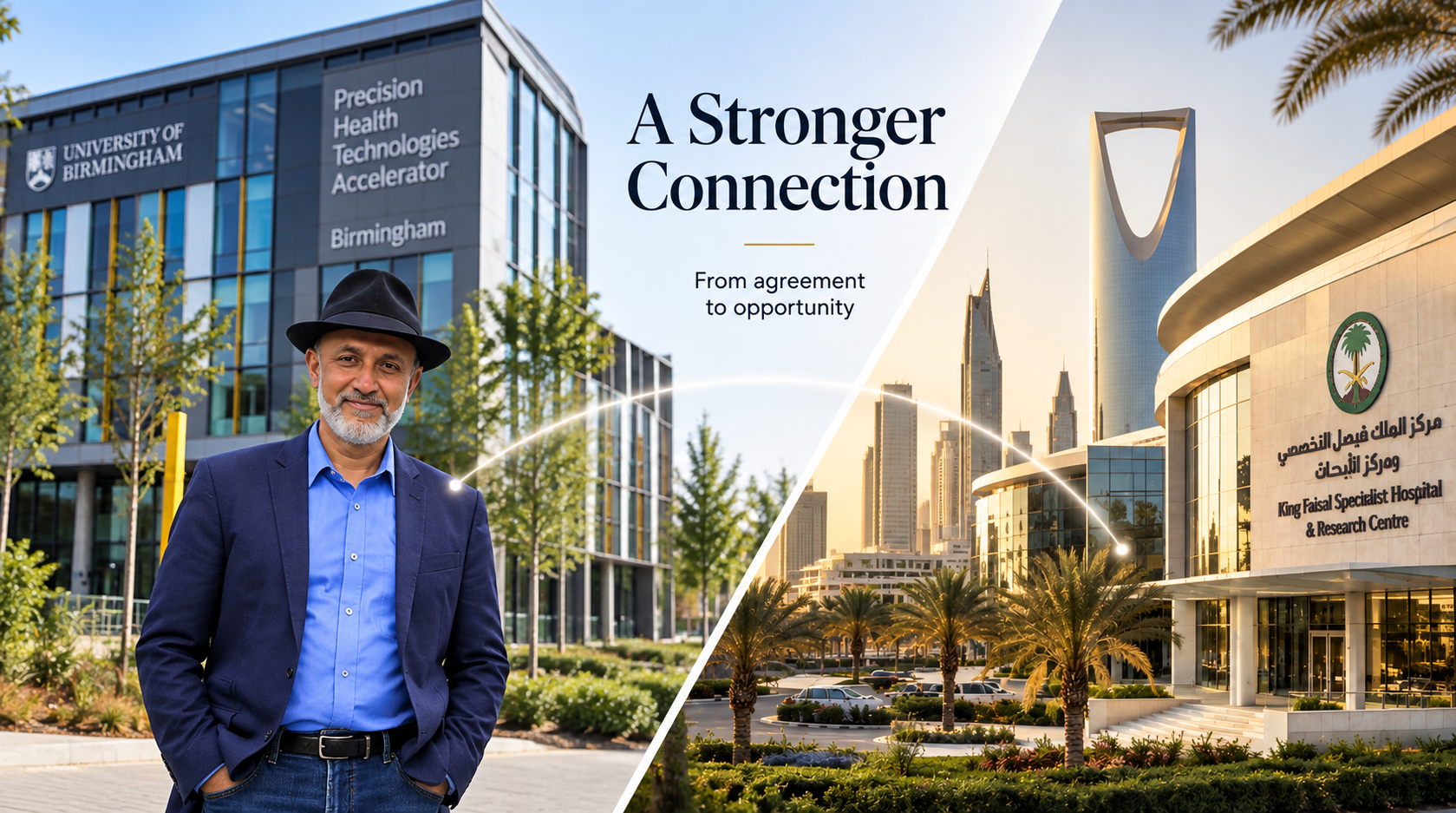
The UK and Gulf are removing barriers to trade. The bigger opportunity is what we choose to build between them.
On 20 May 2026, after years of negotiation, Britain and the six Gulf states announced that they had reached agreement on a new free trade deal.
Somewhere inside that agreement are numbers that will make boardrooms pay attention. UK-GCC trade is already worth £53 billion. Medical devices are among the sectors expected to benefit. Tariffs will fall, barriers will come down and ministers expect billions of pounds of additional economic activity.
For a MedTech CEO sitting in Birmingham, the conclusion seems obvious: the Gulf just moved closer.
Except, of course, Riyadh hasn’t moved an inch. Neither has Birmingham.
The distance that matters was never simply geographical.
Trade agreements matter. They can remove friction, create confidence and give businesses reasons to look again at markets they may previously have considered too difficult. The UK-GCC agreement is particularly interesting because it is not simply about selling more British goods overseas. It covers investment, services, digital trade and professional mobility as well as goods. The Government estimates that it could increase bilateral trade by almost 20 per cent over the long term.
But an agreement between governments cannot manufacture a relationship between two companies, persuade an investor in Abu Dhabi to look seriously at Birmingham, or give a British MedTech founder the credibility to get beyond a first meeting in Riyadh.
That is why I have found myself thinking about a different question.
What would it take for the West Midlands to become one of the places through which some of this new opportunity actually flows?
Not another trade mission, nor another map of international connections but something more durable. A corridor.
When does a network become a corridor?
The distinction matters.
A network tells you who knows whom. A corridor becomes valuable when something useful starts moving through it. That could be Gulf investment finding its way into a West Midlands life sciences company, a British medical device business developing a serious presence in Saudi healthcare, a Gulf company choosing Birmingham as part of its route into the UK, or researchers and clinicians finding one another because somebody understood the value of connecting them.
And crucially, that movement has to work in both directions.
I am wary of framing the Gulf simply as somewhere British businesses should go and sell things. Saudi Arabia and the UAE are building increasingly sophisticated healthcare, investment and innovation ecosystems of their own. If we approach the relationship believing that Britain supplies the expertise while the Gulf supplies the capital and customers, we will misunderstand the opportunity before we have even begun.
The more interesting question is what each ecosystem has that is genuinely useful to the other.
That is particularly relevant here in the West Midlands. We have major universities, NHS institutions, health innovation infrastructure, clinical expertise, MedTech businesses and a growing life sciences economy. The region is also actively seeking international investment and positioning health and life sciences among the areas in which it wants to grow.
But possessing assets and connecting them internationally are two different things.
The challenge is to make the West Midlands useful enough that an investor, healthcare leader or company in the Gulf has a reason to come here, just as we want our own companies and innovators to have credible reasons to go there.
That is when this becomes more interesting than exporting.
The architecture nobody sees
I think there are three parts to this.
The first is institutional. Governments create trade frameworks. Regulators establish the rules. Universities, healthcare systems and economic development organisations provide much of the infrastructure around them.
The second is commercial. There have to be companies worth investing in, technologies worth adopting, clinical problems worth solving and opportunities substantial enough to justify somebody getting on an aircraft.
The third is human.
And this may be the easiest part to underestimate.
Earlier this year I interviewed Taqua Malik for Signal Before Scale. Taqua grew up in Riyadh before spending 15 years working in international Western law firms in Dubai. I wanted to understand something quite specific: why can a Western company do almost everything apparently right in the Gulf, get the meetings, make the presentations, receive a warm response, and still struggle to turn that activity into meaningful commercial progress?
We ended up talking much less about selling than I expected. In fact, we talked about trust.
Taqua made an observation that resonated with me. The first meeting is not necessarily the important one. What starts to tell you something is whether you are invited into conversations two, three and four.
That sounds almost trivial until you think about what is happening underneath it.
A first meeting can be arranged. A conference can put two people in the same room. A government delegation can create an introduction. But repeated access is different. Somebody has decided that the relationship is worth continuing.
And then there is another level again: somebody is prepared to introduce you to a person whose relationship matters to them.
After the conversation, we researched some of these ideas rather than simply accepting them because they sounded plausible.
There is established research around trust transfer, where trust in a known third party can influence initial trust towards someone previously unknown. There is also evidence from signalling and certification research that helps explain why certain introductions carry more weight than others. An endorsement means more when the person making it has something of their own at stake if their judgement turns out to be poor.
I find that particularly relevant to the idea of an economic corridor. Why? Because you can build the institutional architecture from the top down. Human architecture tends to grow differently.
It accumulates.
The opportunity after the agreement
This is where the timing becomes interesting.
The free trade agreement has been negotiated and, at the time of writing, the UK Government is preparing for the next stages before it comes into force. In early September, the UK trade minister said Britain was ready to sign the agreement within weeks.
So there is a window here.
The obvious response is to identify British companies that might benefit from the agreement. We should absolutely do that.
But there is another question worth asking at the same time.
What would make the West Midlands one of the natural UK destinations for Gulf healthcare investment, companies and partnerships?
That requires us to look at our region from the outside. If I were running a healthcare company in Riyadh and considering Britain, why Birmingham?
If I represented a family office or investment organisation in Abu Dhabi looking for healthcare innovation, where would I find the opportunities here that were actually worth seeing?
If I wanted to collaborate with the NHS, a university or a MedTech business, who would help me understand how the pieces fit together?
And on the other side, if I were running a West Midlands MedTech company and saw Saudi Arabia on the board’s growth plan, would I have relationships strong enough to understand the market before committing serious capital to it?
Those are corridor questions. They are also questions that cannot be answered by one organisation.
Government has a role but so do organisations responsible for inward investment and regional growth. Universities, the NHS, investors, founders, clinicians and people who have spent years developing relationships across the Gulf all hold different pieces of the puzzle.
Perhaps our first job isn’t to create something new at all. It is to see whether we can connect what already exists more intelligently.
Birmingham and Riyadh haven’t moved
And yet something has changed since 20 May. The economic distance between them has the potential to become smaller.
Not because the flight is shorter, but because some of the institutional friction that separates the two economies is being removed. The question is whether we use that moment simply to generate another round of trade activity, or whether we build relationships capable of lasting beyond it.
I can imagine what the latter might look like. A Saudi healthcare leader visiting Birmingham doesn’t spend two days being presented to. They meet the clinicians, founders and researchers who are relevant to the problems they are actually trying to solve.
A Gulf investor isn’t handed a directory of West Midlands companies. Somebody who understands both sides introduces them to three opportunities worth their time and is prepared to stand behind those introductions.
A Birmingham MedTech founder doesn’t arrive in Riyadh with a translated sales deck and a list of prospects. They arrive with enough understanding of the ecosystem, and enough trusted relationships within it, to know where they might genuinely belong.
Perhaps, over time, something else begins to happen. People come back.
The introductions become reciprocal. One collaboration leads to another. A company establishes itself here. Another establishes itself there. An investor who came to look at one opportunity hears about another. A clinical relationship becomes a research project, which becomes something commercially useful.
At that point nobody needs to announce that a corridor has been created.
You know it exists because things are moving through it.
The UK-GCC agreement gives us an unusual moment to explore whether some of that movement could pass through the West Midlands. The ingredients are not all ours, and they should not be. A genuine corridor has two ends and has to create value at both.
That is what makes the opportunity exciting.
On 20 May, Riyadh didn’t move any closer to Birmingham. But perhaps the distance between the people building the future of healthcare in both places just became a little easier to cross.
Harun Rabbani is the founder of Precilium and host of Signal Before Scale Conversations. He works with scaling MedTech and life sciences organisations on leadership architecture and strategic search, while developing relationships across the West Midlands and international healthcare ecosystems.
Frequently Asked Questions
What is the UK-GCC Free Trade Agreement?
The agreement is between the UK and the six members of the Gulf Cooperation Council: Bahrain, Kuwait, Oman, Qatar, Saudi Arabia and the United Arab Emirates. Negotiations concluded in May 2026. It covers goods, services, investment and digital trade, with medical equipment and life sciences among the areas expected to benefit. The agreement still needs to complete the necessary steps before entering into force.
Why does this matter to MedTech and life sciences companies?
Removing tariffs and other barriers can make cross-border business easier, but healthcare is rarely a simple export transaction. Regulation, procurement, clinical adoption, local partnerships and trusted relationships still matter. For a MedTech board, the FTA may improve the conditions for expansion, but it doesn’t remove the need to understand how the healthcare ecosystem actually works.
Why focus on the West Midlands?
The West Midlands already brings together significant NHS, university, clinical, MedTech and health innovation capabilities. The more interesting question is whether those assets can become sufficiently connected internationally that Gulf investors, companies and healthcare leaders see the region as somewhere worth coming to, rather than the relationship operating only in the other direction.
What do you mean by a health and life sciences corridor?
Not another membership network or series of trade missions. I mean a relationship between two ecosystems through which useful things repeatedly move: investment, companies, innovation, clinical expertise, research, talent and commercial opportunity. The important word is repeatedly. A single delegation or transaction doesn’t make a corridor.
Why is trust so important if there is a formal trade agreement?
Because governments can reduce institutional friction, but they cannot decide who trusts whom. In my recent Signal Before Scale conversation with Taqua Malik, we explored how relationships develop across Gulf business environments and why the second, third and fourth conversations can tell you more than the first meeting. Our subsequent research also found established evidence around trust transfer and the signalling value of introductions where the introducer has their own reputation at stake.
So are you proposing a new West Midlands-GCC organisation?
No. At least, that isn’t the starting point. There are already governments, investment organisations, universities, healthcare institutions and businesses doing important work on both sides. I’m more interested in whether we can connect some of what already exists more intelligently. Before creating another organisation or network, it seems worth understanding what would actually need to move, where the gaps are, and who needs to be in the room.
Sources
UK and Gulf strike historic multi-billion-pound trade deal
UK And GCC Conclude First-Of-Its-Kind Free Trade Agreement
Gulf Cooperation Council concludes key free trade agreement with UK
Spotlight: The UK-Gulf States Free Trade Agreement
UK ready to sign Gulf deal within weeks, says Trade Minister
Leave a Reply